


The path to sustainable bunkering runs through compliance and documentation
As new fuels scale, every delivery brings more data, more verification, and more safety requirements. Ofiniti is the partner that makes this complexity manageable, giving suppliers the digital infrastructure needed to document, trace, and execute modern bunker operations with confidence.
Ofiniti Impact Report 2025
Enabling the Transition
2025 was the year maritime bunkering crossed a threshold:
Digitalisation and decarbonisation stopped being separate agendas within bunkering. Alternative fuels are moving from pilot stage to scaled supply, biofuels, LNG, methanol, ammonia, but they bring complexity, documentation demands and safety requirements that manual processes cannot handle.
That is where Ofiniti quietly became infrastructure. Before electronic Bunker Delivery Notes were mandated in Singapore or widely discussed across the industry, we had already begun digitising operations in North-West Europe. What is now becoming a global expectation began as a practical response to operational friction, making documentation clearer, aligning stakeholders, and reducing manual burden.
The transition is accelerating - and Ofiniti is already in it.
New fuels are not theoretical anymore. Fleets are being equipped for them, and bunkering operations are becoming compliance-driven and data-intensive.
Across our network this year:
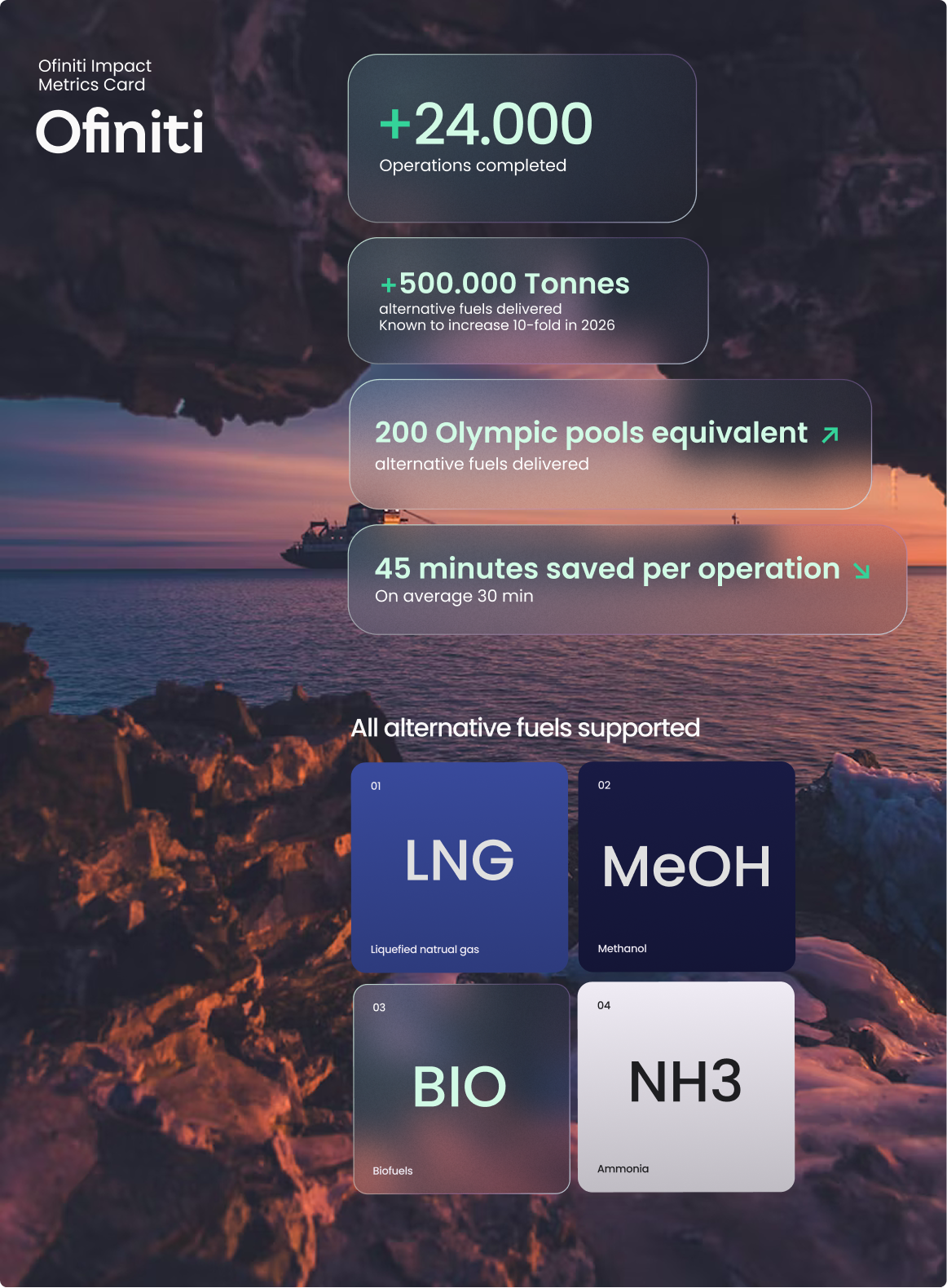
- More than 24,000 digital bunker operations were executed
- Suppliers on Ofiniti delivered 500,000 tonnes of alternative fuels, equivalent to filling 200 Olympic pools
- First deliveries of 100% bio-LNG and B100 UCOME were completed and documented digitally
These are not experiments, they are the operating reality for modern suppliers.
LNG, compared to conventional supply brings a greenhouse gas reduction of up to 23% well-to-wake, and bio-LNG can deliver more than 70% reduction depending on production pathway. Those gains are only meaningful if they can be verified and trusted, which is exactly why documentation requirements expand with lower-carbon fuels.
Alternative fuels demand digital rails
Every low-carbon fuel increases:
- documentation volume,
- safety steps,
- traceability requirements, and
- reporting obligations.
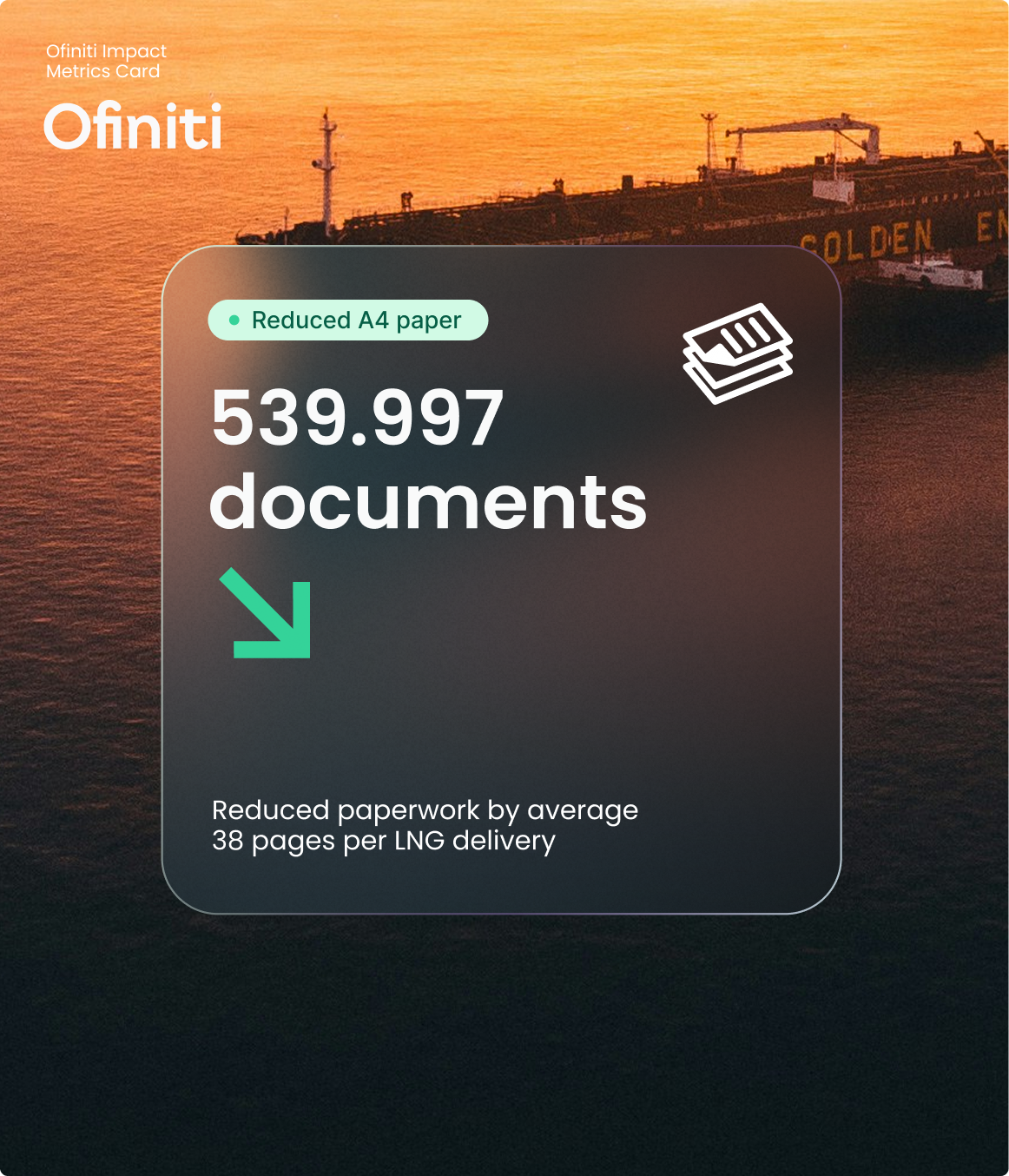
Historically, a bunker operation generated upwards of three sets of paper documentation across supplier, receiver, and surveyor, including BDN, logs, safety checklists and other documents.
With alternative fuels, that stack grows with more comprehensive checklists and documentation of the lifecycle emission profile.
FuelBoss automates that burden.
It standardises the process, gives every stakeholder the same data, and creates the digital custody chain required to validate the sustainability of new fuels.
Efficiency is sustainability
The impact isn’t only compliance.
Digitising operations has direct ESG benefits:
- 45 minutes saved per delivery, meaning higher utilisation and less idle time
- Documentation can start before arrival, alongside, reducing operational stress
- Fewer crew hours spent outside in bad weather and frees up time for crew to focus on safety
- Traceable records reduce disputes and simplify audits
These effects compound.
Small time savings translate into lower emissions, safer operations, and more rested crews.
More than a tool, a required platform for the fuel transition
Alternative fuels are being adopted because they reduce emissions.
But they can’t scale without:
- transparent documentation,
- verified custody chains,
- compliance reporting, and
- safety workflows.
FuelBoss is already doing this across all current low-carbon fuels, biofuels, LNG, methanol, and ammonia, and has even supported hydrogen trials.
In a world where 9% of the fleet is already alternative-fuel-capable and adoption continues to rise, digital infrastructure is becoming the enabling technology.
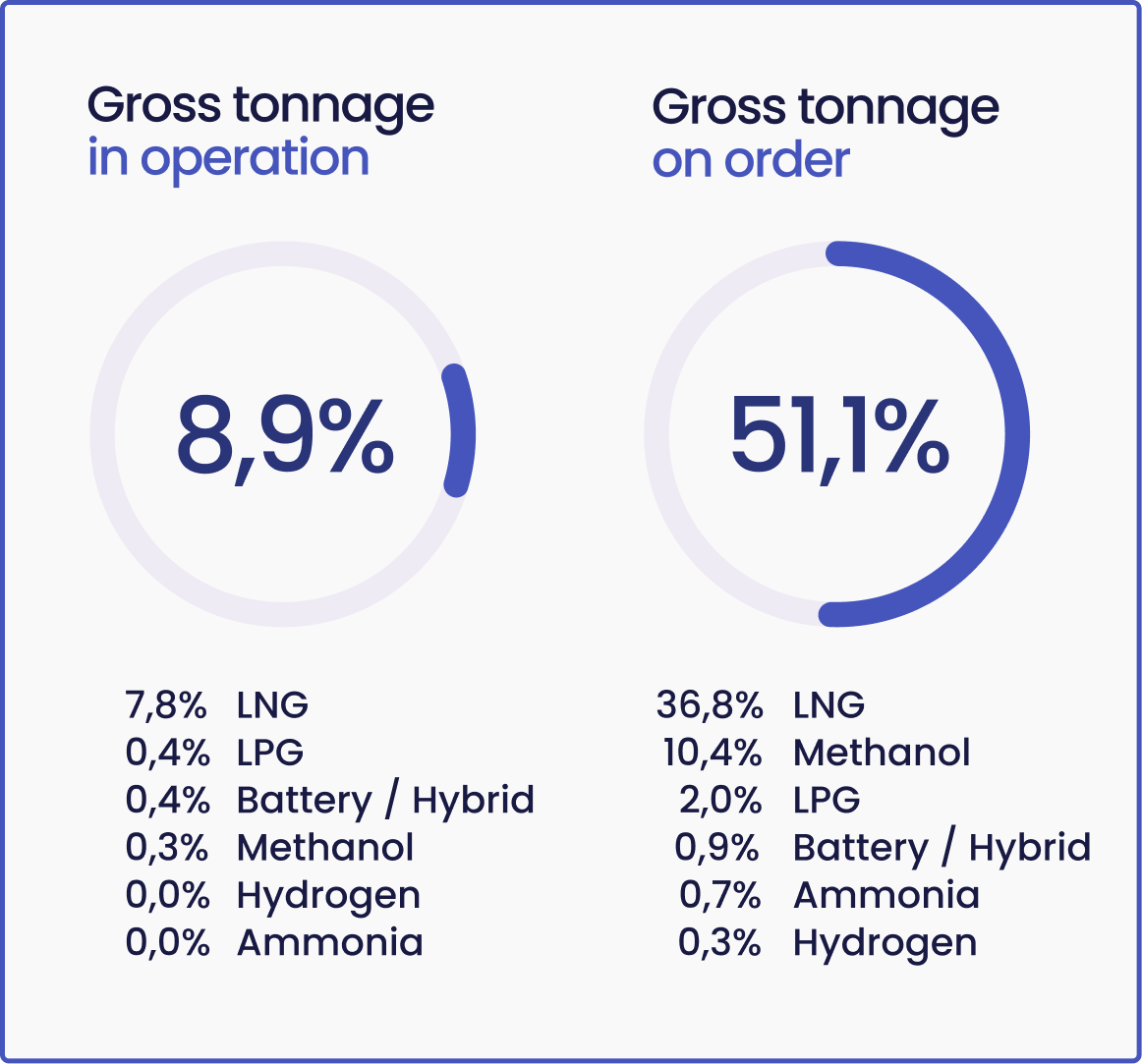
Numbers by DNV
Looking ahead

“The next phase of the energy transition is not only about new fuel molecules; it is about proof, integrity, safety, and interoperability.
Ofiniti is positioned as the system that enables these flows, the unseen operating layer that lets the energy transition actually work at scale.”